

Turn the key, tap the screen, and music fills the cabin. It feels instant. Underneath that simplicity sits a small chain of components working together, each one passing a signal to the next until it becomes the sound you hear.
Understanding how a car audio system works helps with more than trivia. It helps you shop smarter, install safer, and troubleshoot faster when something in the chain breaks down. It also stops you from paying for upgrades that won’t actually fix the problem you’re hearing.
This guide walks through every stage of that chain, from the source of the signal to the speaker cone moving air behind your door panel. By the end, you’ll know exactly which part does what, and why a weak link anywhere along the way can drag the whole system down.
Every in-car audio system, from the cheapest factory radio to a six-figure custom build, relies on the same basic structure. A complete car audio system is really just five parts working in sequence, and each one has a specific job.
Strip away the marketing and every setup uses this structure. What changes is the quality of each part and how well they’re matched together.
A factory system usually squeezes all five parts into as little space as possible, often with the amplifier built straight into the head unit. That keeps costs down, but it also means one weak link, usually cheap speakers, holds the whole system back.
An aftermarket build separates these parts out. A dedicated head unit feeds a standalone amplifier, which drives speakers and a subwoofer chosen specifically for the vehicle and the listener. Nothing here is complicated on its own. What matters is that every part is rated to work with the ones around it, since a mismatched amplifier and speaker pairing will underperform even with expensive gear.
Sound in a car audio system starts as a digital file or a radio signal. From there, it passes through the head unit, an optional processor, an amplifier, and finally the speakers and subwoofer, arriving as the physical vibration your ears register as sound.
Wiring car audio system components incorrectly at any of these four stages is the single biggest cause of distorted, quiet, or completely dead audio. A loose ground wire or an undersized power cable can undo an otherwise excellent set of speakers.
Say you stream a song from your phone over Bluetooth. The head unit receives that digital signal and runs it through a digital-to-analogue converter, turning it into an electrical waveform. That waveform then travels down a signal cable to the amplifier, still far too weak to move anything on its own.
The amplifier multiplies that weak signal into something with real power behind it, then sends it down thicker speaker wire to each driver. Inside the speaker, that electrical current passes through a coil, which reacts with a magnet to push the speaker cone back and forth. That movement pushes air, and that moving air is what your ears pick up as music. The whole trip, from phone to eardrum, happens in a fraction of a second.
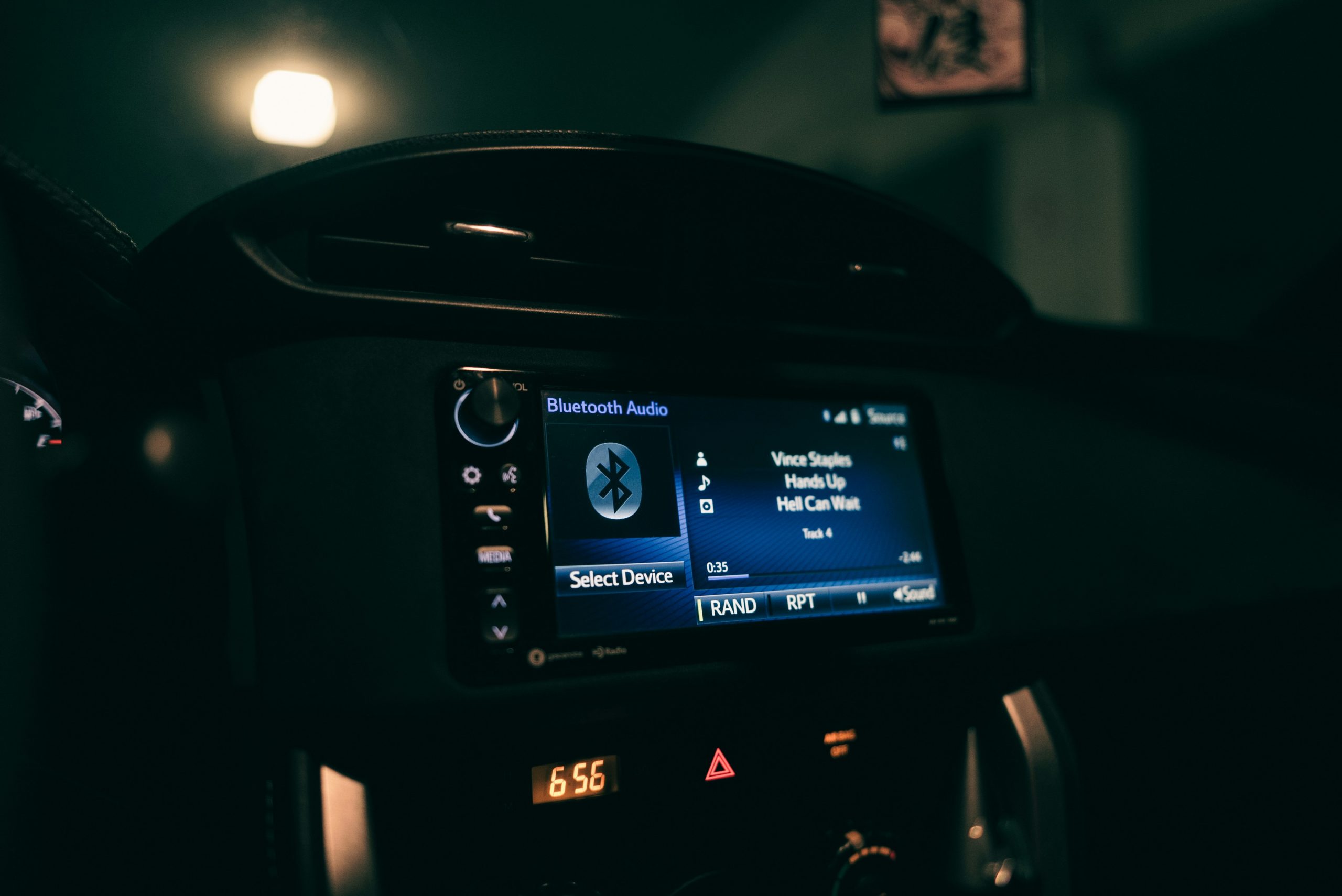
The head unit is the part you interact with directly. It’s the screen or dial in your dashboard, and it does three jobs: selecting the source, adjusting basic settings, and sending the signal onward.
Most head units sold today double as a car audio system with Bluetooth built in, so you can stream music or take calls without a cable. Many higher-end units also work as a car audio system with GPS navigation layered on top of the standard audio functions, and some support wired Apple CarPlay for a steadier connection than Bluetooth alone.
Upgrading just the head unit unlocks features many factory units skip, including better Bluetooth codecs, Android Auto support, and cleaner pre-amp outputs for adding an amplifier down the track.
Head units produce a signal, but it’s too weak to move a speaker cone properly on its own. That’s where amplification comes in.
This is the amplifier car audio system builders rely on to turn a weak signal into something loud enough to drive a full set of speakers, sometimes multiplying the power by ten times or more. A standalone amplifier handles that job far more cleanly than the small amplifier built into most factory head units, with less distortion once the volume climbs. You’ll find a full range of amplifiers and accessories in our products range if you’re ready to start comparing options.
Amplifiers come in different channel counts. A two-channel amp suits a pair of speakers or a single subwoofer. A four or five-channel amp can run a full set of speakers plus a subwoofer from one box, which keeps wiring simpler in smaller vehicles.
Between the head unit and the amplifier, many systems include a digital signal processor, often shortened to DSP. It doesn’t add power. It shapes the signal before amplification, and that shaping is what separates a system that just plays music from one that sounds properly balanced.
A crossover splits the signal by frequency, sending bass to the subwoofer and higher frequencies to the speakers, so each component only handles the range it was built for. Time alignment corrects for the fact that speakers sit at different distances from your ears, delaying the closer ones so all the sound arrives together. Equalisation then smooths out any frequencies your cabin naturally boosts or cuts, since a car’s interior shape affects tone as much as the gear does.
None of this is essential for a basic setup. For anyone chasing genuinely accurate sound rather than just louder sound, it’s often the difference that matters most.
Everything before this point exists to feed a clean, powerful signal to the speakers. Any audio system car speakers discussion starts with two basic types.
Choosing the right speakers for car audio system upgrades comes down to matching power handling, size, and mounting depth to your specific vehicle. A speaker rated well above your amplifier’s output will sound flat. One rated too low will distort or fail under load. If yours are already showing signs of wear, our car speaker replacement guide covers what to look for.
Standard speakers reproduce midrange and high frequencies well, but they struggle with deep bass. That’s why a car audio system with subwoofer support exists as its own category. Subwoofers are built to move a large volume of air at low frequencies, something a 6.5-inch door speaker was never designed to do.
Great components mean nothing if the wiring behind them is wrong. This is also the stage where most DIY builds go sideways, and it’s not always obvious whether a stopped system needs a simple repair or a full replacement. Our guide on repairing versus replacing a car stereo walks through how to tell the difference.
Every vehicle on Australian roads runs on a 12-volt electrical system, and your car audio system taps directly into it. For a closer look at how that broader network operates, see our guide to vehicle wiring in Australian cars. Proper car audio system installation covers power wiring from the battery, a solid chassis ground, signal cables between components, and speaker wire matched to distance and power. Get the gauge wrong on a long power run and you’ll lose voltage before it even reaches the amplifier.
Wire gauge matters more than most people expect. A thin cable run from the battery to a powerful amplifier will heat up under load, waste power as resistance, and can become a fire risk over time. As a rough guide, longer runs and higher-powered amplifiers both call for thicker cable, and a fuse near the battery protects the whole run if something downstream ever short-circuits. Skipping that fuse is one of the more common shortcuts that turns a minor fault into a serious one.
If you’re looking up how to install car audio system components yourself, start with the power and ground connections. These carry the most current and cause the most damage when done poorly, including blown fuses, melted wiring, and in rare cases, electrical fires.
Once everything is connected, how to setup car audio system settings correctly is its own step. This means setting gain levels on the amplifier, adjusting the head unit’s equaliser, and balancing front-to-back and left-to-right output. Skipping this step is why some systems sound loud but muddy, even with good gear.

Not every system needs a full rebuild. Sometimes a car audio system upgrade means simply swapping factory speakers for better aftermarket ones, or adding a small amplifier to an existing head unit. This entry-level tier usually delivers the biggest jump in sound quality for the smallest spend, since factory speakers are often the weakest link in an otherwise decent system.
A mid-tier upgrade typically adds a dedicated amplifier and a subwoofer, giving the system proper bass and cleaner power at higher volumes. It’s a solid stopping point for most drivers, and it covers the gap between “fine” and “genuinely good” without touching the interior. Our car audio system upgrade guide breaks down options at every price point if you want a fuller picture before deciding.
Other times, the goal is a ground-up build. Custom car audio systems are built around one vehicle and one set of listening preferences, often including fibreglass enclosures, matched component sets, and multiple amplifiers tuned specifically for that car. These builds cost more, but they close the gap between factory sound and what a dedicated setup can actually deliver.
A custom build usually starts with a conversation rather than a parts list. A good installer will want to see the vehicle, hear what kind of music you listen to, and understand how loud or how accurate you actually want the result before recommending anything. That upfront planning is what separates a custom system that gets used every day from one that ends up sounding impressive but impractical.
Either way, the same chain applies. A custom build is just a more refined version of the same head unit, amplifier, speaker, and wiring sequence found in every car audio system on the road.
Basic speaker swaps are within reach for anyone comfortable with a screwdriver and a multimeter. Full amplifier installs, subwoofer wiring, and anything involving the vehicle’s factory computer systems are a different story, and it’s worth reading why we usually recommend leaving these jobs to the professionals before attempting them yourself.
Modern vehicles run multiple electronic control units alongside the audio system, and a wiring mistake can affect more than your music. A short circuit near safety systems, or an incorrectly wired ground, can cause problems well beyond a blown fuse.
For anything past a simple speaker upgrade, a professional installer brings the tools, testing equipment, and vehicle-specific knowledge to get it right the first time, and to back the work with a warranty.
A car audio system isn’t complicated once you see it as a chain: source, head unit, amplifier, speakers, and the wiring holding it all together. Understanding each link makes it far easier to diagnose a problem, plan an upgrade, or simply choose gear that actually suits your car.
If you’re after a small speaker swap or a complete car audio system rebuild, getting the fundamentals right from the start saves money, time, and a lot of frustration down the track.
Getting it right also comes down to who does the work. Xtreme Car Audio has been Sydney’s go-to name for car audio since 2008, with a team of award-winning, licensed installers behind every job. Every installation carries a lifetime warranty, and the Blacktown workshop handles everything from a single speaker swap to a full custom fit-out, along with same-day diagnostics and repairs for systems that have stopped sounding right.
Thinking about an upgrade or a custom build? Get in touch with the team at Xtreme Car Audio for advice, a quote, or a same-day repair.